Top 10 Leading Natural Rubber Producing and Exporting Countries in 2025: Essential Statistics and Insights
0
(0)
Have you ever wondered where the essential material powering everything from vehicle tires to medical equipment originates, shaping global industries and economies? Natural rubber stands as a cornerstone of modern manufacturing, derived primarily from the latex of rubber trees in tropical climates, and its production and trade influence billions in international commerce. In 2025, the worldwide natural rubber market continues to thrive, with leading producers and exporters dominating supply chains amid rising demand for sustainable and high-quality materials. This exploration highlights the top natural rubber producing countries in the world 2025, emphasizing their roles as major rubber exporting countries that fuel automotive, healthcare, and consumer goods sectors. As climate changes and technological advancements reshape agriculture, these nations remain pivotal, offering insights into global rubber production trends 2025 and the strategies that position them as elite rubber suppliers.
1. Thailand
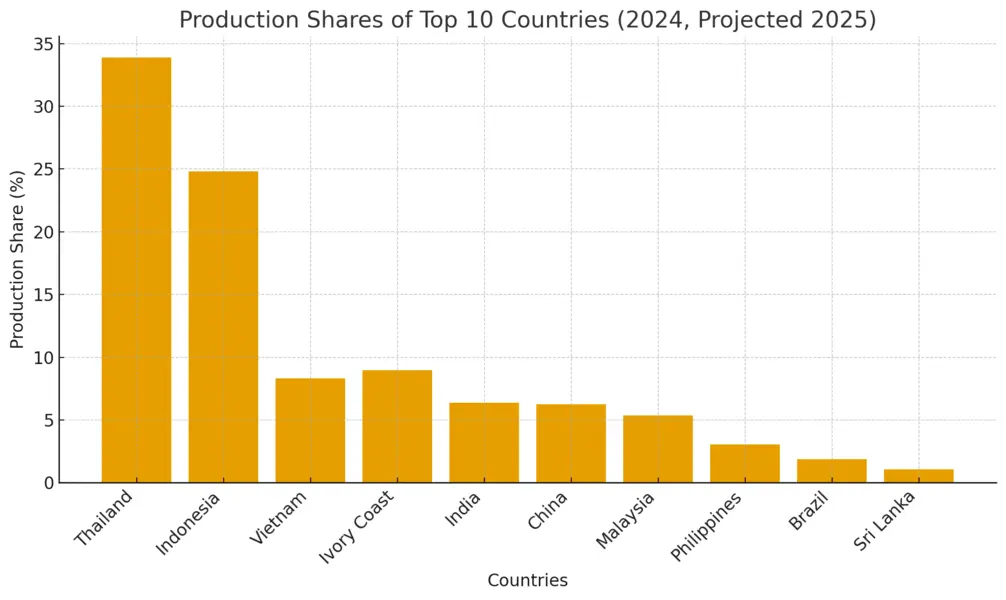
Thailand reigns as the foremost natural rubber producer and exporter globally, consistently yielding around 4.85 million metric tons annually, which positions it as a supreme force in the sector. Its vast plantations in the southern regions benefit from ideal tropical conditions, including ample rainfall and fertile soil, enabling high yields from Hevea brasiliensis trees that are meticulously managed through advanced tapping techniques. As one of the leading rubber exporting countries, Thailand ships out billions in value each year, primarily to markets like China and the United States, bolstering its economy where rubber accounts for a significant portion of agricultural GDP. Major rubber suppliers in Thailand, such as cooperatives and large estates, emphasize sustainability certifications to meet international standards, reducing deforestation and enhancing traceability in supply chains. What factors contribute to Thailand’s status as the top natural rubber producing country in the world 2025? The answer lies in government support through subsidies, research into disease-resistant varieties, and efficient logistics networks that facilitate rapid exports, ensuring Thailand remains an elite player amid fluctuating global prices. Furthermore, the country’s integration of technology, like drone monitoring for plantation health, sets a benchmark for other rubber exporting countries seeking to optimize output.
2. Indonesia
Indonesia stands out as a premier natural rubber powerhouse, producing approximately 3.55 million metric tons yearly, making it a key contender among top natural rubber producing countries in the world 2025. The archipelago’s diverse islands, particularly Sumatra and Kalimantan, host extensive smallholder farms that contribute to over 80% of production, relying on traditional yet effective methods adapted to volcanic soils and monsoon patterns. As a major rubber exporting country, Indonesia directs substantial volumes to Europe and Asia, with exports valued at around $2.9 billion, supporting livelihoods for millions in rural areas. Rubber suppliers across Indonesia focus on improving quality through better processing facilities, which minimize contamination and enhance the material’s suitability for high-end applications like aircraft tires. How does Indonesia balance environmental concerns with its role in global rubber production trends 2025? By implementing reforestation programs and promoting agroforestry, the nation addresses deforestation risks while maintaining its position as an outstanding exporter. Additionally, investments in biotechnology for higher-yielding clones ensure long-term viability, solidifying Indonesia’s influence in international markets.
3. Vietnam
Vietnam emerges as an elite natural rubber producer, outputting about 1.19 million metric tons each year, rapidly ascending the ranks of rubber exporting countries through strategic expansions in the Central Highlands. The country’s favorable climate, with consistent humidity and temperatures, supports dense plantations managed by state-owned enterprises and private firms that prioritize efficient irrigation and pest control. Serving as a vital rubber exporting country, Vietnam generates around $1.9 billion in export revenue, mainly supplying automotive industries in Japan and South Korea, where demand for durable latex products remains high. Local rubber suppliers invest in modern vulcanization processes to produce superior grades, attracting foreign buyers seeking reliable sources amid supply chain disruptions. What challenges do emerging rubber exporting countries like Vietnam face in sustaining growth? Climate variability and labor shortages prompt innovations such as mechanized tapping, which boost productivity and reduce costs. Moreover, Vietnam’s participation in trade agreements enhances its market access, positioning it as a top-tier supplier in the Asia-Pacific region.
Ivory Coast holds a prominent position among leading rubber exporting countries, with production nearing 1.29 million metric tons, driven by expansive plantations in the western forests that thrive in equatorial conditions. The nation’s focus on small-scale farmers, supported by international aid for training and equipment, has propelled output, making it Africa’s foremost rubber hub. As a key rubber exporting country, Ivory Coast earns approximately $2.5 billion from shipments to Europe and North America, where its high-quality rubber is integral to tire manufacturing and industrial goods. Rubber suppliers in Ivory Coast emphasize ethical sourcing, complying with EU deforestation regulations to maintain export competitiveness. Why has Ivory Coast surged ahead in global rubber production trends 2025? Government initiatives for infrastructure development, including better roads for transport, combined with foreign investments in processing plants, ensure efficient market delivery. This approach not only elevates economic stability but also fosters community development through job creation in rural areas.
5. India
India distinguishes itself as a top-tier natural rubber producer, generating around 911,000 metric tons annually, primarily from Kerala and Tamil Nadu states where monsoon-fed plantations yield resilient crops. The country’s integrated approach, blending traditional farming with scientific research from institutions like the Rubber Board, enhances disease resistance and yield per hectare. While domestic consumption is high due to a booming automotive sector, India still contributes as a rubber exporting country, sending surplus to neighboring nations and earning substantial foreign exchange. Major rubber suppliers in India prioritize organic methods to appeal to eco-conscious buyers, reducing chemical use and promoting biodiversity. How can established producers like India adapt to shifting demands in rubber exporting countries? By diversifying into value-added products like latex concentrates, India strengthens its market presence. Furthermore, subsidies for replanting old trees ensure sustained production, underscoring India’s role in global supply stability.
6. China
China commands respect as a superior natural rubber producer, with an output of about 892,000 metric tons, concentrated in Hainan and Yunnan provinces where subtropical climates support large-scale cultivation. State-backed research into hybrid varieties has boosted efficiency, allowing for higher densities and faster maturation cycles in plantations. As the world’s largest importer due to massive industrial needs, China also functions as a rubber exporting country for processed goods, leveraging its production to feed domestic tire giants like Michelin affiliates. Rubber suppliers in China adopt advanced automation in harvesting, minimizing labor costs and maximizing output quality. What role does technology play in elevating China’s status among top natural rubber producing countries in the world 2025? Innovations such as AI-driven monitoring systems predict yields accurately, aiding in strategic planning. This technological edge positions China as a formidable player in balancing production and consumption.
7. Malaysia
Malaysia asserts its authority as a prime natural rubber producer, yielding approximately 767,000 metric tons yearly from Peninsular and East Malaysian estates renowned for their high productivity. Historical expertise, dating back to colonial introductions, combines with modern sustainability practices to maintain soil health and combat leaf diseases. Ranking among prominent rubber exporting countries, Malaysia exports around $1.2 billion worth, targeting markets in the Middle East and Southeast Asia for premium latex applications. Local rubber suppliers collaborate on certification programs like the Malaysian Sustainable Natural Rubber initiative, ensuring traceability and appealing to global buyers. How do historical legacies influence current strategies in rubber exporting countries like Malaysia? By building on established supply chains, Malaysia integrates blockchain for transparent transactions, enhancing trust. Such measures secure its enduring influence in the industry.
8. Philippines
The Philippines emerges as a noteworthy natural rubber producer, contributing about 439,000 metric tons, mainly from Mindanao regions where volcanic soils and typhoon-resistant strains thrive. Government programs encourage smallholders through cooperatives, providing seeds and training to improve tapping efficiency and post-harvest handling. While primarily meeting domestic needs, the Philippines participates as a rubber exporting country, shipping to nearby Asian markets and generating revenue for rural economies. Rubber suppliers here focus on community-based models, fostering inclusive growth and resilience against price volatility. Why are smaller-scale producers like those in the Philippines vital to global rubber production trends 2025? Their agility allows quick adaptation to market shifts, such as increasing demand for eco-friendly rubber. This grassroots approach complements larger players, adding diversity to supply.
Brazil maintains a solid footing as a natural rubber producer, producing around 267,000 metric tons from Amazonian and southern plantations that echo the material’s native origins. Efforts to revive domestic output, including incentives for sustainable harvesting, counter historical declines caused by blight. As an emerging rubber exporting country, Brazil directs exports to Latin American and European partners, emphasizing hypoallergenic varieties for medical uses. Major rubber suppliers in Brazil advocate for forest conservation, integrating rubber with other crops in agroforestry systems. What potential does Brazil hold for expanding among leading rubber exporting nations statistics? With vast untapped lands and research into resistant clones, Brazil could amplify its share significantly. This positions it as a strategic alternative source in diversified global chains.
10. Sri Lanka
Sri Lanka rounds out the top ranks as a respected natural rubber producer, outputting approximately 151,000 metric tons from hilly estates in the central and southern provinces. The island’s temperate climate and skilled workforce enable precise cultivation, with emphasis on quality over quantity for niche markets. Functioning as a rubber exporting country, Sri Lanka supplies high-grade latex to industries in India and Europe, supporting its export-oriented economy. Rubber suppliers prioritize fair trade practices, ensuring worker welfare and environmental compliance. How do island nations like Sri Lanka contribute uniquely to the landscape of rubber exporting countries? Their focus on specialty products, such as organic rubber, fills gaps left by mass producers. This specialization enhances global variety and resilience.
Notable Other Countries
Liberia: A rising African contender with production around 200,000 metric tons, Liberia excels as a rubber exporting country, shipping to the US and Europe through historic plantations revived post-conflict, emphasizing sustainable yields.
Myanmar: Producing about 250,000 metric tons, Myanmar serves as an key Asian rubber supplier, exporting to China amid political challenges, with potential for growth through improved infrastructure.
Cambodia: With output nearing 300,000 metric tons, Cambodia stands among emerging rubber exporting countries, focusing on border trade with Vietnam and Thailand for raw latex.
Ghana: Generating around 150,000 metric tons, Ghana’s rubber sector boosts exports to Europe, leveraging West African climates for steady supply as a reliable rubber supplier.
Guatemala: Contributing approximately 100,000 metric tons, Guatemala exports quality rubber to North America, integrating it with coffee farming for diversified agriculture.
Nigeria: Around 140,000 metric tons in production, Nigeria aims to expand exports within Africa, addressing domestic gaps while positioning as a future major rubber supplier.
Conclusion
The top natural rubber producing countries in the world 2025, which also dominate as rubber exporting countries, demonstrate remarkable resilience and innovation in meeting global demands for this vital commodity. Their collective output not only sustains industries but also drives economic development in tropical regions, highlighting the interplay between agriculture and international trade. As climate shifts pose new challenges, these nations invest in sustainable practices to secure future supplies, ensuring they remain elite rubber suppliers. Looking ahead, advancements in biotechnology and trade policies will likely elevate production efficiency, benefiting both producers and consumers worldwide. Ultimately, understanding these dynamics equips stakeholders to navigate the evolving landscape of global rubber production trends 2025 with confidence.