Top 10 Countries With The Largest Unmined Gold Reserves in the World (Updated 2026)
0
(0)
Gold remains one of the most sought-after commodities on the planet, serving as a hedge against inflation, a store of value during uncertainty, and a critical component in jewelry, electronics, and central bank reserves. As global demand continues to surge amid economic volatility and geopolitical shifts, attention turns to nations holding the greatest untapped potential. The top countries with the largest unmined gold reserves command significant influence over future supply chains and market dynamics. Data from the U.S. Geological Survey, as highlighted by Visual Capitalist in 2025 estimates (updated for 2026 context with prevailing high gold prices), reveals a concentrated distribution of these resources. Russia and Australia lead decisively, each possessing vast deposits that could shape the industry for decades. These reserves represent not just economic wealth but also strategic advantages in an era where resource security matters more than ever. Understanding where the world’s remaining gold lies helps investors, policymakers, and industry leaders anticipate trends in mining, exploration, and international trade.
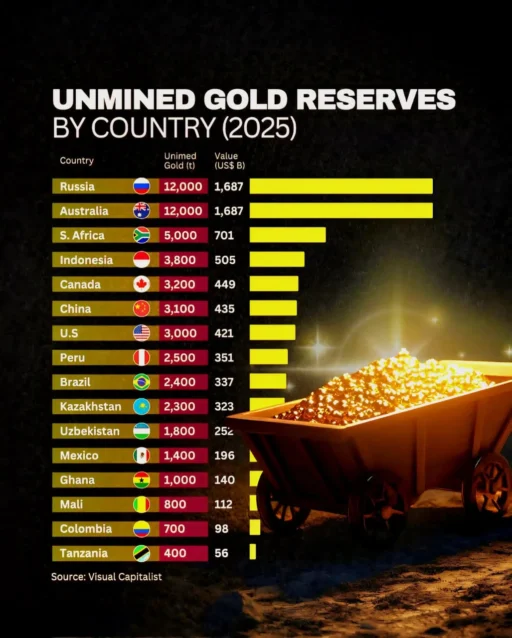
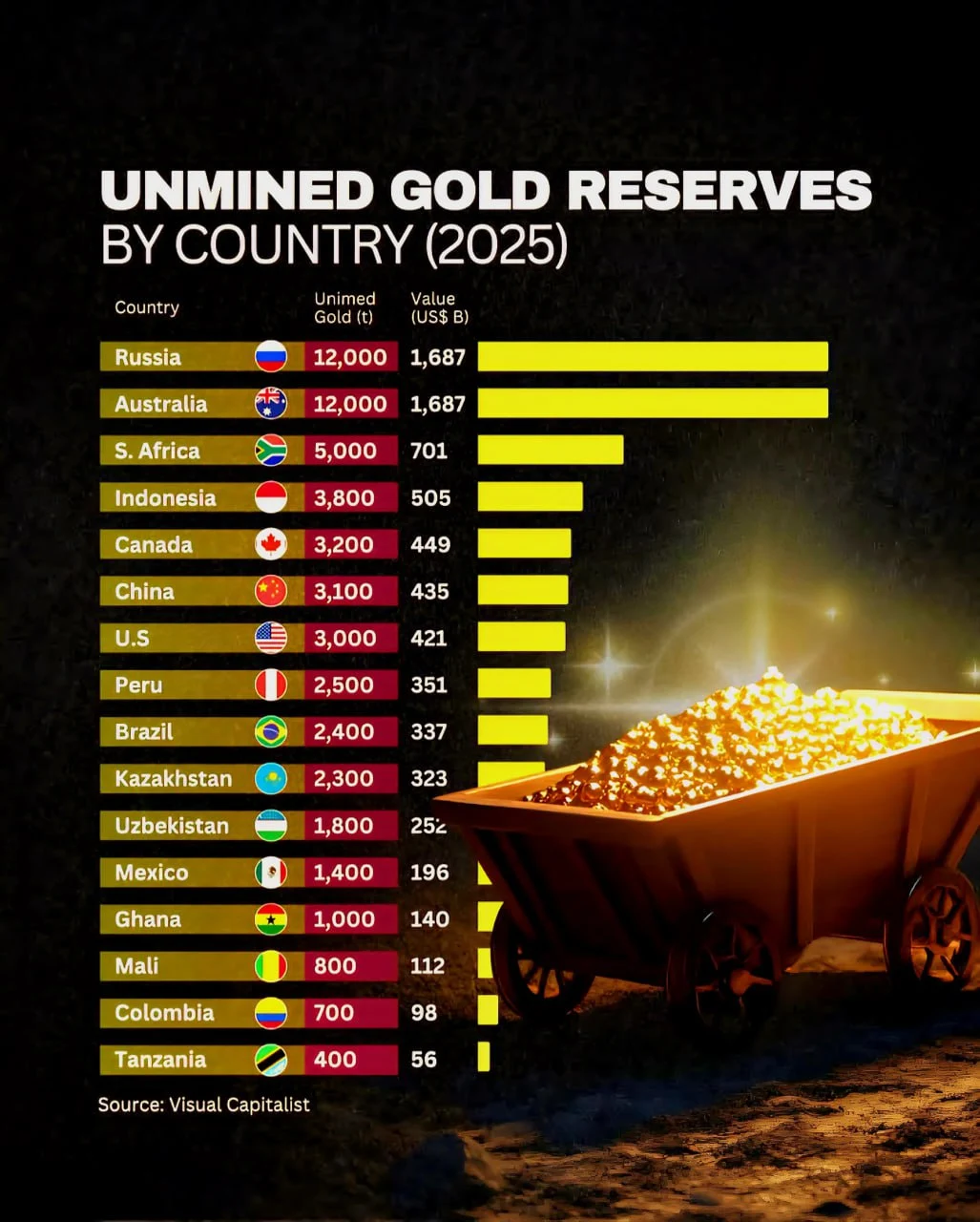
Unmined Gold Reserves Statistics (2025 Data, Valued at Approximately $4,362 per troy ounce)
Rank
Country
Unmined Gold (tonnes)
Value (US$ Billion)
1
Russia
12,000
1,687
2
Australia
12,000
1,687
3
South Africa
5,000
701
4
Indonesia
3,800
505
5
Canada
3,200
449
6
China
3,100
435
7
United States
3,000
421
8
Peru
2,500
351
9
Brazil
2,400
337
10
Kazakhstan
2,300
323
These figures underscore the immense scale of untapped wealth, with the top 10 nations controlling the majority of known economically recoverable deposits worldwide.
1. Russia
Russia stands among the foremost nations with exceptional unmined gold resources. Its massive 12,000 tonnes of reserves place it in a tied leading position globally, concentrated heavily in remote yet mineral-rich territories across Siberia and the Far East. Major areas such as Krasnoyarsk, Magadan, Amur, and Chukotka districts host significant undeveloped deposits that promise substantial future output. The country’s strategic approach to resource management emphasizes long-term development, bolstered by state-backed exploration and advanced extraction technologies. As gold prices remain elevated in 2026, Russia’s untapped reserves offer a powerful economic buffer and geopolitical leverage. This dominant holding ensures Russia will continue influencing global gold markets for years ahead.
2. Australia
Australia matches Russia with an equally impressive 12,000 tonnes of unmined gold, establishing it as one of the premier destinations for gold-related investment. The bulk of these reserves lies within the highly prospective Yilgarn Craton in Western Australia, recognized as one of the planet’s richest mineral provinces. Mature mining infrastructure combined with ongoing exploration programs supports efficient future development of these assets. Australia benefits from stable regulatory frameworks and strong environmental standards that attract leading international mining companies. Its consistent ranking among the top gold producers complements these vast reserves, creating a robust ecosystem for sustained growth. In an industry seeking reliable supply, Australia’s holdings represent some of the finest opportunities available.
3. South Africa
South Africa holds a formidable 5,000 tonnes of unmined gold, securing its place as a historic powerhouse in the sector. Decades of mining expertise have left the nation with deep geological knowledge of its Witwatersrand Basin and surrounding formations, where significant deposits still await extraction. Challenges such as deeper mining conditions have slowed development, yet technological advances in safety and efficiency open new pathways forward. The country’s reserves contribute substantially to its economy, supporting jobs and regional development initiatives. South Africa’s enduring legacy in gold underscores its potential to remain a key player despite evolving market conditions. These assets highlight the nation’s continued relevance in supplying one of the world’s most valuable metals.
Indonesia possesses 3,800 tonnes of unmined gold, ranking it prominently among nations with superior resource endowments. The archipelago’s volcanic geology fosters numerous high-grade deposits, particularly in regions like Papua and Sulawesi, where exploration continues to yield promising results. Government policies increasingly balance economic growth with sustainable practices, encouraging responsible development of these reserves. Indonesia’s strategic location and growing domestic processing capabilities enhance the value of its untapped gold. As global demand for responsibly sourced materials rises, the country’s holdings position it as a vital contributor to future supply. Its reserves reflect the immense potential found across Southeast Asia’s mineral frontiers.
5. Canada
Canada features 3,200 tonnes of unmined gold, affirming its status among the elite resource-holding nations. Vast territories in provinces such as Ontario, Quebec, and British Columbia contain numerous advanced exploration projects with substantial defined resources. The country’s rigorous permitting processes and commitment to Indigenous partnerships ensure projects advance thoughtfully and sustainably. Canada excels in applying cutting-edge technologies for both exploration and low-impact mining operations. Its stable political environment and transparent regulations make it a preferred jurisdiction for major investors seeking premier opportunities. These attributes combine to make Canada’s gold sector one of the most attractive worldwide.
6. China
China controls 3,100 tonnes of unmined gold, placing it firmly within the upper tier of global reserve holders. Domestic deposits span diverse geological settings across provinces in the west and northeast, supporting both large-scale operations and smaller high-grade finds. The nation continues investing heavily in geological surveying and modern mining methods to unlock additional value from these assets. China’s dual role as a leading producer and consumer of gold amplifies the strategic importance of its untapped reserves. State-driven initiatives focus on securing long-term supply while advancing technological self-reliance in the sector. This comprehensive approach ensures China maintains strong influence over gold dynamics moving forward.
7. United States
The United States holds 3,000 tonnes of unmined gold, demonstrating its significant yet sometimes underappreciated resource base. Key deposits exist in Nevada, Alaska, and other western states, where world-class mines already operate alongside promising undeveloped sites. Federal and state regulations emphasize environmental stewardship alongside economic benefits from resource extraction. The U.S. benefits from sophisticated infrastructure and access to capital markets that facilitate large-scale project financing. As a major economy with diverse industrial needs, its reserves provide both commercial and strategic depth. America’s gold potential remains a cornerstone for domestic supply security and international market participation.
8. Peru
Peru accounts for 2,500 tonnes of unmined gold, highlighting its prominent standing in South American resource rankings. The Andean region hosts numerous polymetallic deposits where gold occurs alongside other valuable minerals, enhancing overall project economics. Peru has developed extensive expertise in high-altitude and complex terrain mining, supporting efficient reserve development. Government efforts to formalize small-scale operations complement larger corporate projects targeting these untapped assets. The country’s reserves contribute meaningfully to export revenues and local community development when managed responsibly. Peru exemplifies how focused investment can transform natural endowments into sustained economic advantages.
Brazil maintains 2,400 tonnes of unmined gold, solidifying its role as a noteworthy holder of premium resources in Latin America. Deposits concentrate in the Amazon region and Minas Gerais, areas known for their geological diversity and exploration upside. The nation continues refining regulatory frameworks to promote sustainable practices while encouraging responsible mining investment. Brazil’s vast territory offers ample scope for new discoveries that could expand its already substantial reserve base. Integration with other mineral sectors, such as iron ore and bauxite, creates synergies for multi-commodity operations. These factors position Brazil as a country with exceptional long-term potential in the gold domain.
10. Kazakhstan
Kazakhstan rounds out the leading group with 2,300 tonnes of unmined gold, reflecting its growing importance in Central Asian mining. The country’s steppe and mountain regions contain several advanced projects supported by modern infrastructure inherited from Soviet-era developments. Kazakhstan actively pursues foreign partnerships and technology transfers to accelerate reserve monetization. Its strategic location along key trade routes enhances the appeal for export-oriented gold production. Stable governance and resource nationalism balanced with investment incentives create a favorable operating climate. Kazakhstan’s reserves underscore the broader potential emerging from well-managed resource economies.
Conclusion
The distribution of the world’s largest unmined gold reserves highlights a clear concentration among a select group of nations that will shape the future of gold supply. Russia and Australia lead with unparalleled holdings, followed by established players like South Africa and rising contributors across Asia and the Americas. These top reserves not only represent enormous economic value but also carry implications for investment flows, technological innovation in mining, and geopolitical considerations. As gold prices stay robust throughout 2026 and beyond, countries with the finest untapped deposits stand to gain substantial advantages through careful development. Investors and industry observers would do well to monitor these nations closely, as their resources could prove decisive in meeting global demand for this timeless precious metal. Responsible extraction practices will determine how effectively these assets deliver benefits while preserving environments for future generations.